Quantum Random
Number Generator
A Quantum Random Number Generator (QRNG) is a hardware device that generates true random numbers by measuring unpredictable quantum physics phenomena, such as the behaviour of light particles (photons). Unlike traditional software-based generators that rely on predictable mathematical formulas, QRNGs tap into the fundamental laws of physics to deliver absolute, un-hackable randomness — the bedrock on which every secure Indian digital system, from banking to national defence, must be built.
Key Features of QRNG
Every design decision in our QRNG module is made with one goal — entropy that no adversary, classical or quantum, can predict, replicate, or manipulate.
True Physical Entropy
Randomness is harvested directly from quantum-mechanical events such as photon emission and detection timing — never derived from a deterministic algorithm or seed value.
Defence-Grade Security
Built to the Tri-Services mandate for absolute cryptographic isolation, delivering pure physical entropy that can only be bypassed by physically altering the quantum source hardware.
Hybrid CSPRNG Architecture
A dual-engine design pairs hardware-derived quantum randomness with high-speed Cryptographically Secure Pseudo-Random Number Generators for maximum, sustained throughput.
NIST & TEC Certified
Fully compliant with NIST SP 800-90B standards for non-deterministic random number generators, and certified under TEC criteria for Indian telecom deployments.
High-Throughput Entropy Feed
Feeds high-entropy seeds directly into the key-generation routines of the PQC Web Server, ensuring every issued certificate and key negotiation is securely rooted from the source.
Tamper-Evident Hardware
The quantum source module is physically hardened and self-monitoring, so any attempt at intrusion or interference is detectable and logged in real time.
Why Does Randomness Matter for Cybersecurity?
Every encryption key, digital signature, and session token depends on one hidden ingredient: unpredictability. If an attacker can guess or reconstruct the random numbers a system uses, the surrounding cryptography collapses instantly, no matter how sophisticated.
Conventional PRNGs are deterministic — the same seed always produces the same sequence. This makes them fast, but also means their output can be predicted or reverse-engineered if the seed is ever exposed.
For critical infrastructure — defence, banking, and government identity systems — that risk is unacceptable. Vedic Kavach's QRNG removes it at the root, replacing predictable formulas with true physical randomness that is provably immune to prediction.
Keys & Signatures
Weak entropy is a leading root cause of real-world cryptographic breaches.
Deterministic PRNGs
Identical seeds reproduce identical sequences — a single point of failure.
Physics-Backed Assurance
Grounded in physics, not algorithm secrecy — no guesswork involved.
How a Quantum Random Number Generator Works?
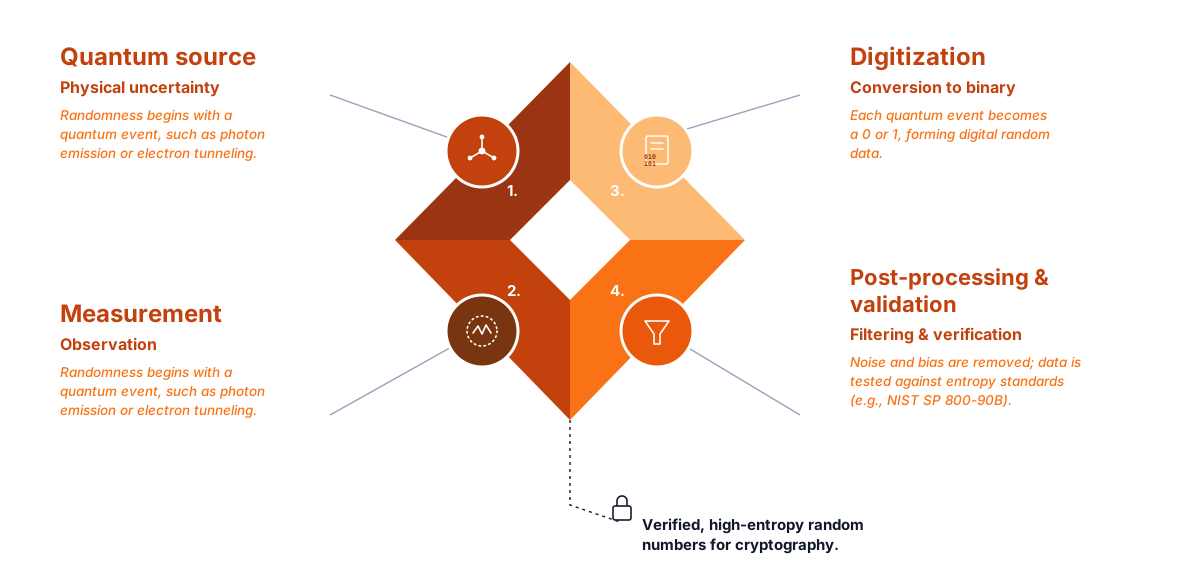
From a single quantum event to a verified, high-entropy number ready for cryptographic use, QRNG output passes through four disciplined stages.
Quantum Source
Every QRNG begins with a quantum process — light particles, electron tunnelling, or vacuum fluctuations — that produces true physical uncertainty at the hardware level.
Measurement
Detectors record outcomes from that quantum process, such as when a photon arrives. Each outcome is genuinely unpredictable, building a stream of random events.
Digitization
Random events are converted into binary form — each detection becomes a 0 or a 1 — turning physical measurements into usable digital data.
Post-processing and validation
Noise and bias are filtered out, and the data is tested against entropy standards such as NIST SP 800-90B before it's confirmed as verified randomness.
The result is verified, high-entropy randomness suitable for secure key generation and cryptographic applications. Essentially, QRNGs don't simulate randomness. They measure it directly from the most unpredictable systems known.
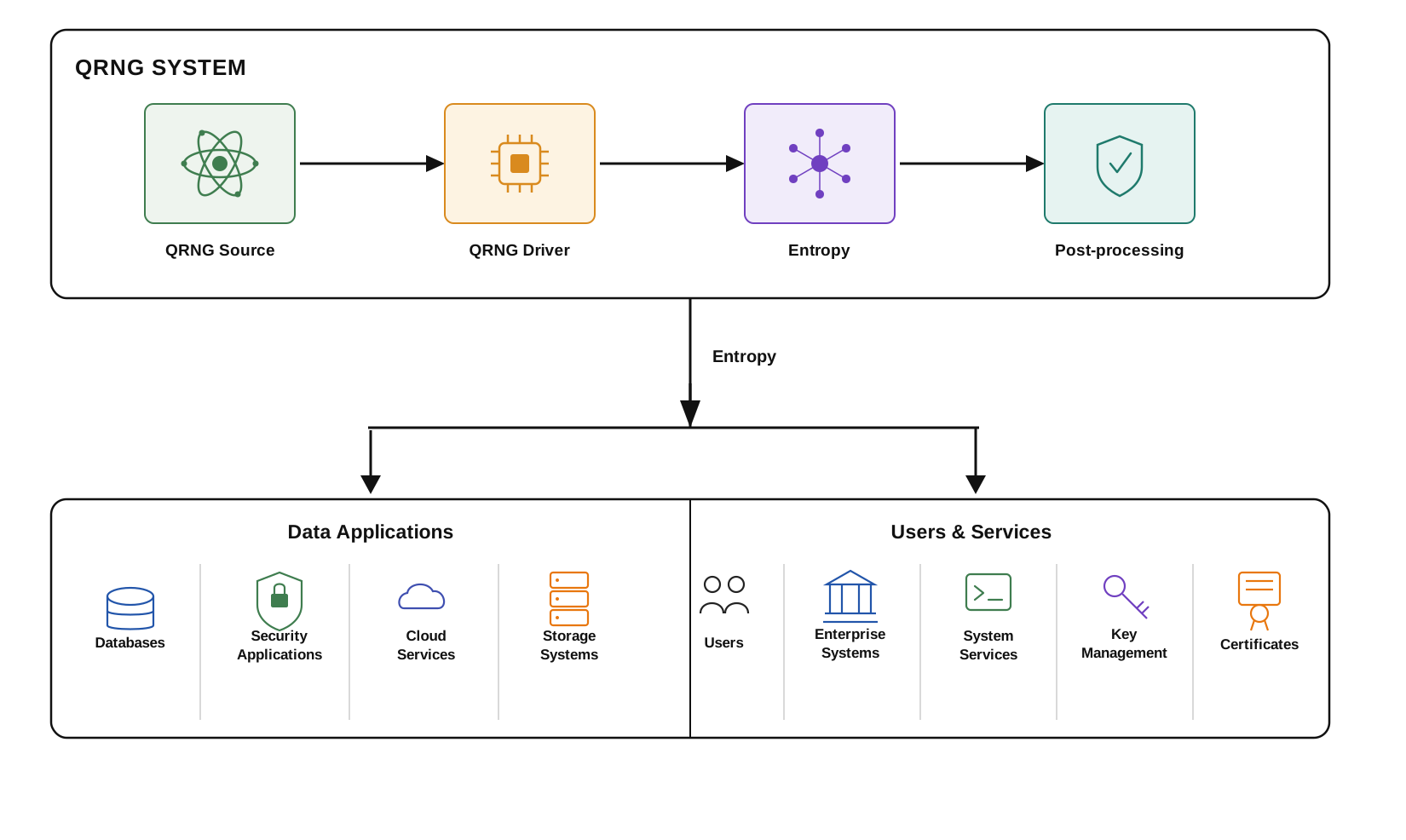
The Quantum Random Number Generator (QRNG) system is built from core hardware modules that generate, timing-measure, digitize, and validate entropy before distribution.
Comparing Random Number Generators for Cryptographic Use
True, quantum, and cryptographic generators are often used interchangeably in conversation — but they rest on entirely different foundations. Here is how they compare across the factors that matter for real-world security.
Applications of QRNG in Cryptography and Security
From securing citizen data to protecting national command networks, high-entropy randomness underpins every layer of India's digital ecosystem.
Banking & Financial Transactions
Secures UPI, card, and banking sessions with unpredictable keys and OTP seeds.
Defence & National Security
Protects classified comms and command systems with adversary-proof entropy.
Blockchain & Digital Assets
Generates tamper-proof private keys and wallet seeds.
Digital Identity & e-Governance
Strengthens Aadhaar-linked platforms against credential prediction.
Cloud & Data Centre Encryption
Roots every key and certificate in true entropy.
IoT, Infrastructure & Telecom (5G/6G)
Secures power grids, industrial control, and next-gen telecom signalling.
Healthcare Data Protection
Safeguards electronic health records and medical IoT data.
Academy & Training
Trains professionals and institutions on quantum-safe security practices.